![[Translate to English:]](/fileadmin/_processed_/0/b/csm_zahlen-fakten-header_95d8a9f6a2.jpg "[Translate to English:]")
Members
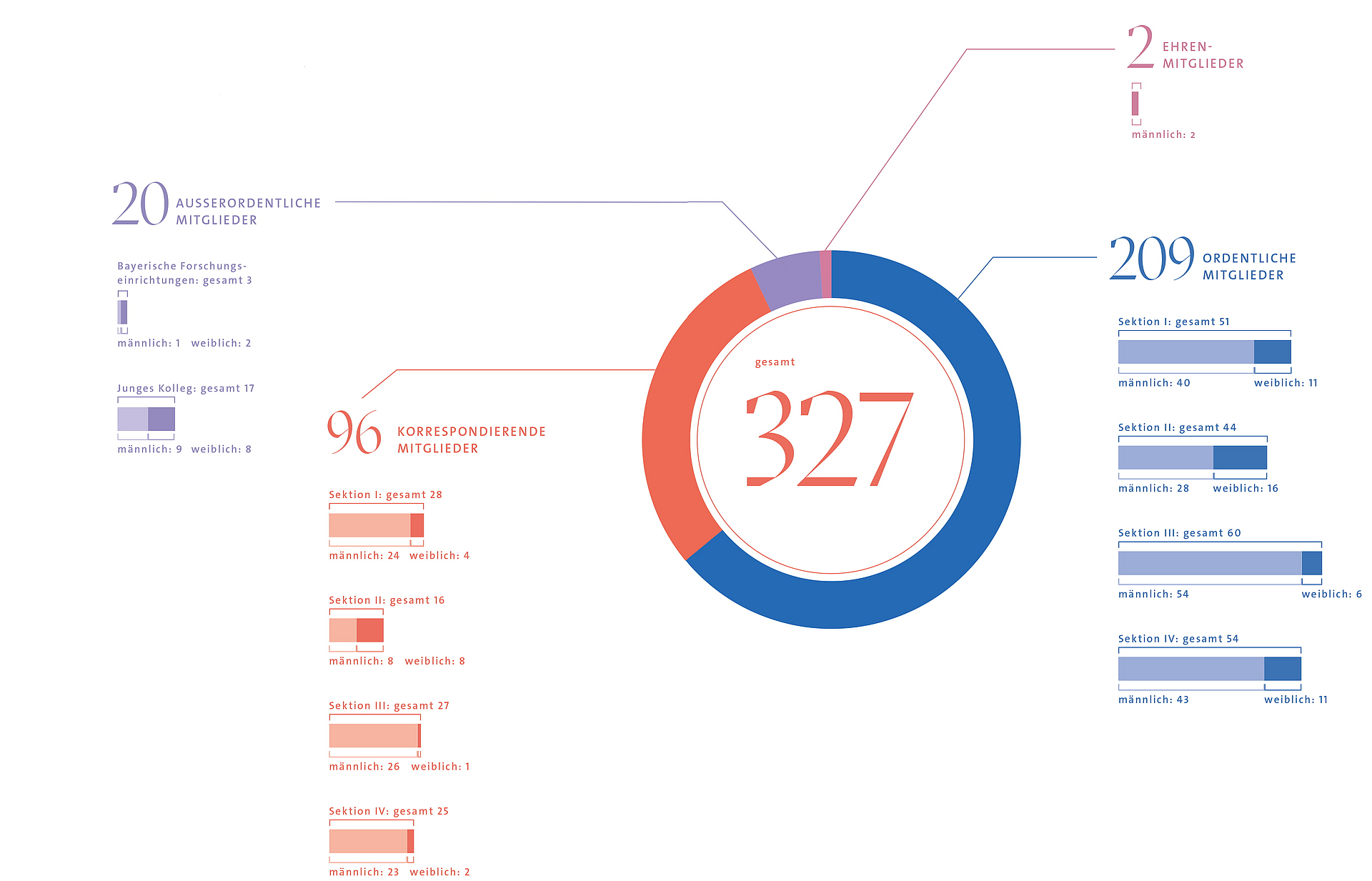
The Academy currently has 200 ordinary members and 106 corresponding members, 21 extraordinary members and two honorary members: Franz, Duke of Bavaria and Prof. Dr. Ing. habil. Ulrich L. Rohde. The proportion of women in the community of scholars currently stands at approximately 20%. Among the extraordinary members (including the Young Academy), the share of women is 50%.
ePaper BAdW
(in German)
Staff
The Academy’s staff is drawn from around 30 countries around the world. Over one quarter of academic staff members are female (34%); among the administrative personnel, the figure is almost half (48%).
Staff statistics
| Anzahl | |
|---|---|
| Female academic staff | 115 |
| Male academic staff | 214 |
| Female non-academic staff | 83 |
| Male non-academic staff | 88 |
| Total | 500 |
Funding
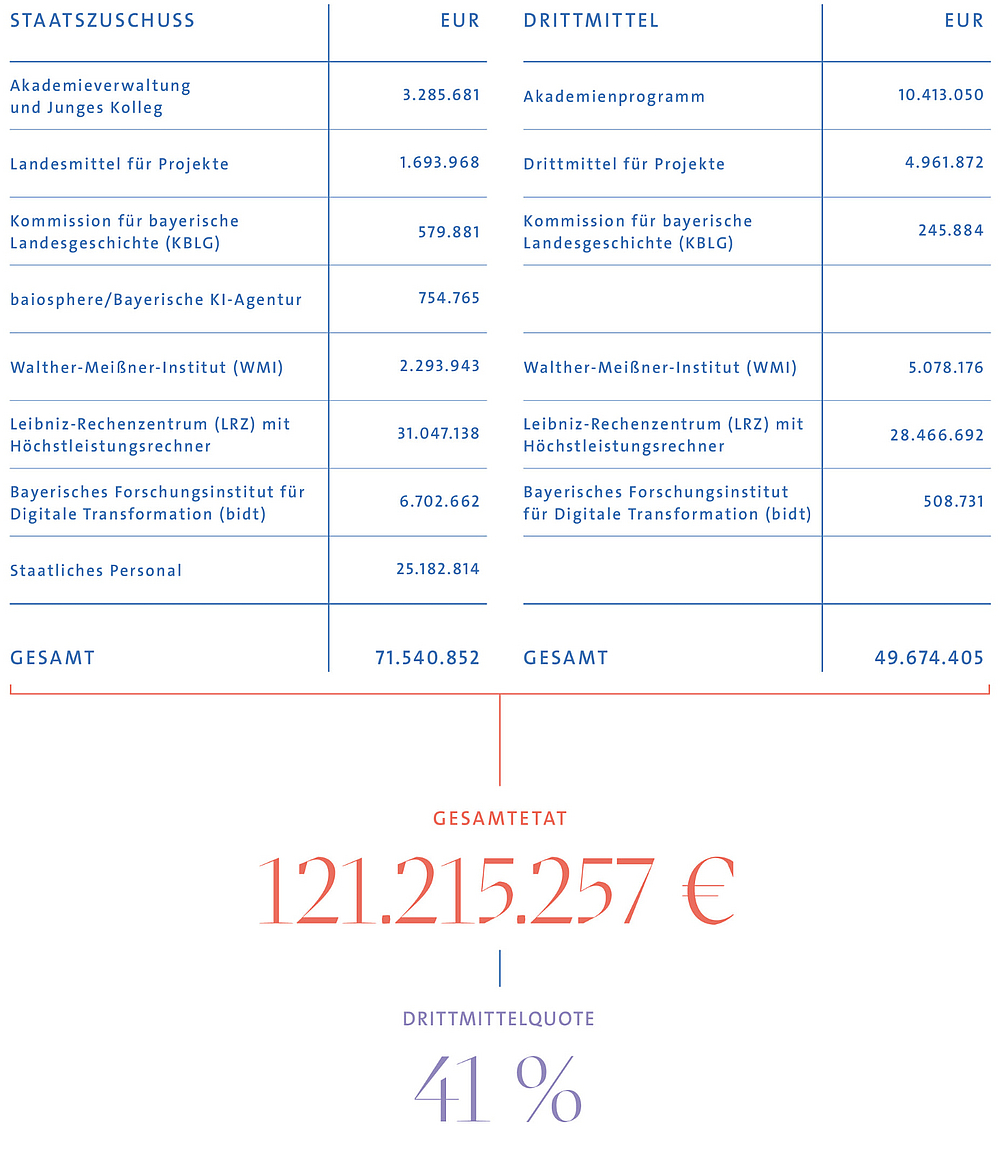
The Free State of Bavaria is the Academy’s main source of funding. A large proportion of the Academy’s annual budget comes from external sources. Funds are raised from the European Union, the German Research Foundation (DFG) and various other foundations.
Locations
The main offices of the Bavarian Academy of Sciences and Humanities (BAdW) are located in the north-east wing of the Residenz royal palace in Munich. There are also satellite offices on the campuses of various Bavarian universities, including Ludwig-Maximilians-Universität in Munich (LMU) and the Julius-Maximilians-Universität in Würzburg (JMU). The Leibniz Supercomputing Centre and the Walther-Meißner-Institute are located on the research campus in Garching, near Munich. The Bavarian Research Institute for Digital Transformation (bidt) at Gabelsbergerstraße 4 is within walking distance of the Academy’s main building.
Links
- Image brochure: The Academy at a glance (German)
- The Academy in 2025: The BAdW Annual in e-paper format (German)
- Maps / Contact: How to find us